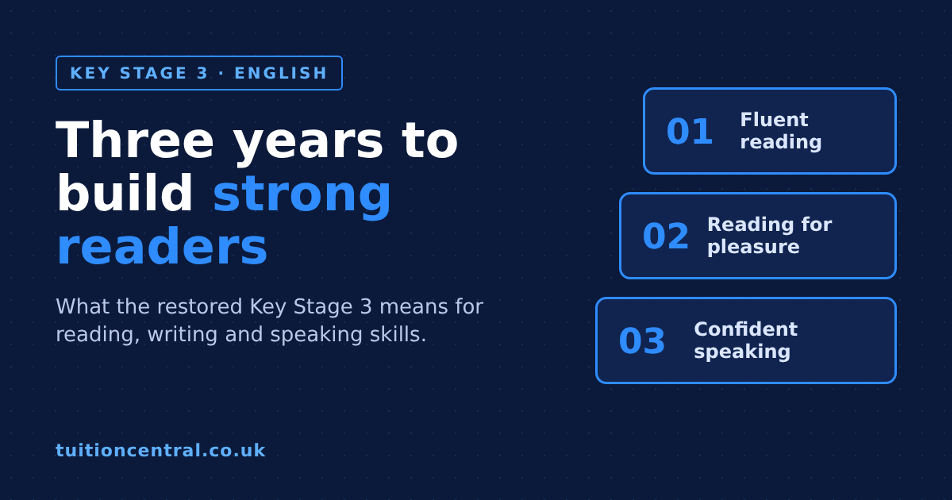
For many families, Years 7 to 9 can feel like a rush towards GCSEs. Some schools start GCSE courses as early as Year 7. On 8 November 2026, the Department for Education announced that this should change. Key Stage 3 in England will be restored as a full, distinct three-year phase.
If your child is in upper primary or the first years of secondary school, this matters. Here is what was announced, what it means for English, and how you can help at home.
What has been announced?
The DfE says schools will be asked to stop bringing GCSE work forward into Key Stage 3. Teachers can still stretch high-achieving pupils, but without narrowing their options early.
The announcement also promises a new national curriculum, written with subject experts. It will slim down overcrowded content and sequence it more clearly. Most importantly for English, it sets higher expectations for oracy (speaking and listening), fluent reading and reading for pleasure.
Education Secretary Lucy Powell said: "The early years of secondary school should be a time when children are excited to go to school."
Why is the government making this change?
The DfE points to worrying signs of disengagement in the early secondary years. According to its figures, the proportion of persistently absent pupils almost doubles between Year 7 and Year 9, reaching one in four.
It also cites research by Public First Global for the International Baccalaureate. More than half of teachers surveyed said GCSE courses dominate the first three years of secondary school.
Reading habits are a related concern. The National Literacy Trust's 2026 survey of more than 125,000 UK children found that just 36.1% of 8 to 18-year-olds enjoy reading in their free time. Only 20.3% read something daily. Both figures rose slightly from 2025 but remain well below 2016 levels.
When will it happen?
Timing is still being confirmed. The full national curriculum is due to be published later this year, and the government has said the new curriculum will be taught from September 2028. Pupils currently in Years 10 and 11 will carry on with their courses as planned.
In the meantime, schools will make their own decisions about timetables. Some trusts have already moved back to a three-year Key Stage 3.
What does this mean for English?
A longer Key Stage 3 gives more time to build the foundations that GCSE English relies on. These include:
Fluent reading: reading accurately, at a good pace and with expression, so that energy goes into understanding rather than decoding.
Reading for pleasure: choosing to read widely, which builds vocabulary and background knowledge.
Oracy: explaining ideas clearly, building on what others say and speaking with confidence.
These skills matter later. GCSE English Language asks students to analyse unseen texts under time pressure. English Literature requires students to write about whole novels, plays and poems. A student who reads fluently and can talk through an idea is far better prepared for both.
The evidence supports this focus. The Education Endowment Foundation (EEF) estimates that oral language approaches add around six months of progress over a year. Reading comprehension strategies, such as questioning, summarising and making inferences, add around seven months. These are averages from research studies rather than guarantees, but they show that talk and active reading make a real difference.
How can parents help at home?
You do not need to wait for the new curriculum. Small, regular habits support exactly the skills that schools will be focusing on.
1. Protect reading time. Aim for 15 to 20 minutes of free-choice reading most days. Comics, non-fiction, sports writing and audiobooks all count. Enjoyment comes first.
2. Talk about what they read. Ask open questions: "Why do you think the character did that?" or "What do you think happens next?" This builds inference, a key skill at every stage.
3. Make everyday talk count. At dinner, invite your child to explain a point of view and give a reason. Gently ask, "Can you tell me more?" This is oracy in practice.
4. Read aloud together. Even in Year 8, reading aloud builds fluency. Take turns with a page each, or listen to them read a short news article.
5. Notice new words. When your child meets an unfamiliar word, talk about what it might mean from the context, then check. A short list on the fridge works well.
6. Stay in touch with school. Ask how English is taught in Years 7 to 9 and whether the school plans any changes. A new Year 8 reading test is also planned in England, and schools will make the results available to parents.
The bottom line
Restoring a three-year Key Stage 3 is a chance to slow down and get the foundations right. For English, that means confident readers who enjoy books and can express their ideas clearly. Those strengths will serve your child well at GCSE and beyond.
If your child would benefit from extra support with reading, writing or speaking skills, Tuition Central's qualified and experienced tutors offer personalised online English lessons from KS1 to A-Level, with a lesson report after every session. Visit www.tuitioncentral.co.uk to book a free consultation.