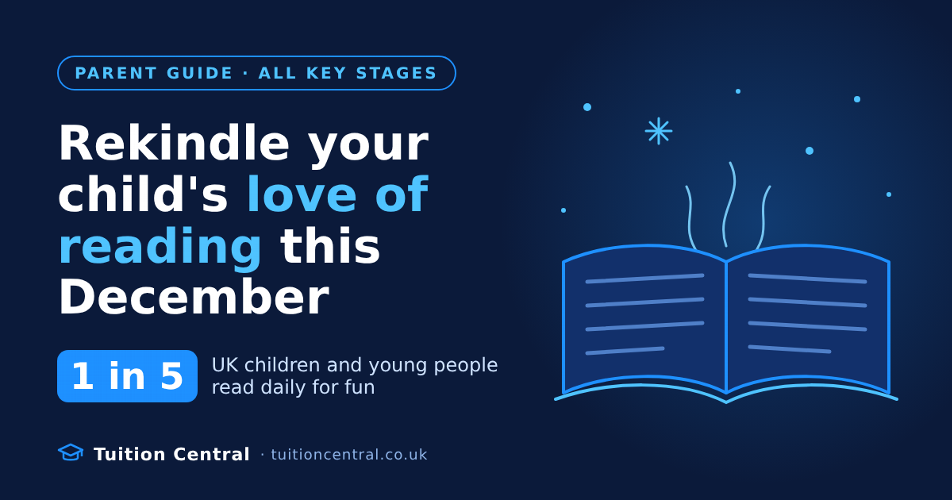
If your child once begged for "one more chapter" but now shrugs at books, you are far from alone. Children's reading for enjoyment in the UK has fallen sharply over the past decade, and many families notice it most in the teenage years.
The good news is that December is one of the best times of year to turn things around. With the school holidays, there is less homework and more time at home, and books are an easy gift. Here is what the latest research shows, and some practical ways to help.
What the latest figures show
The National Literacy Trust's 2026 Annual Literacy Survey asked 125,375 children and young people aged 5 to 18 across the UK about their reading habits. Only 36.1% of 8- to 18-year-olds said they enjoy reading in their free time, and just 20.3% read something daily.
That was a small improvement on 2025, but it is still well below 2016, when 58.6% enjoyed reading and 32.0% read daily. The survey also found that enjoyment fell slightly among 5- to 8-year-olds. They were the only age group to decline, so even young children's love of books cannot be taken for granted.
The issue has reached Parliament. The House of Commons Education Committee has been holding an inquiry into the decline in reading for pleasure. Witnesses have argued that crowded timetables and exam pressure leave little room for independent reading in school.
Why reading for pleasure matters
Reading for fun can feel like a "nice extra" next to homework and revision. The evidence suggests it is much more than that.
A study by researchers at the UCL Institute of Education followed around 6,000 young people from the 1970 British Cohort Study. Children who read for pleasure made more progress between the ages of 10 and 16 in vocabulary, spelling and maths than those who rarely read. The effect was strongest for vocabulary.
Vocabulary underpins success in English at every stage. It shapes how well a seven-year-old understands a story, how precisely a GCSE student analyses language, and how fluently an A-Level student writes an argument. Children who read widely meet words they would rarely hear in conversation.
Practical ways to help this December
You do not need to turn the holidays into a reading programme. Small, relaxed habits work best.
1. Let your child choose. Comics, graphic novels, joke books, football annuals and magazines all count. Enjoyment matters more than format at this stage, so follow your child's interests rather than a "worthy" reading list.
2. Give a book they actually want. Visit a bookshop or library together in December and let your child pick. A book chosen by them is far more likely to be opened than one chosen for them.
3. Read aloud, even to older children. Shared reading is not just for toddlers. Reading a chapter aloud to a nine-year-old, or taking turns with a teenager, makes reading social. It also lets children enjoy stories slightly above their own reading level.
4. Create a "reading nest". Fifteen quiet minutes with blankets, a hot drink and phones in another room can become a cosy holiday ritual. If you read your own book at the same time, you show that reading is something adults choose to do.
5. Try audiobooks on journeys. Long car trips to see family are a perfect time for a shared audiobook. Listening still introduces new words and story structures, and it gives the whole family something to talk about afterwards.
6. Talk about books without testing. Ask "Who was your favourite character?" or "What do you think happens next?" rather than quizzing them on what they read. Conversation keeps reading enjoyable.
7. Link reading to what they are studying. GCSE students might enjoy a modern novel by an author they know from class, or a film adaptation followed by the book. Younger children often love a non-fiction book about a topic they are covering at school.
What if your child is really struggling?
Sometimes a child avoids books not because they are bored but because reading feels hard. Signs include guessing at words, losing track of meaning, or avoiding reading aloud. If you notice these, speak to your child's teacher in the new term. Gentle, regular practice matters more than long sessions, and confidence often grows quickly once a specific difficulty is addressed.
The bottom line
A love of reading is one of the most valuable things a child can carry through school. The December school holidays give families time and space to rebuild it, one comic, chapter or audiobook at a time.
If you would like extra support, Tuition Central offers one-to-one online English tuition from KS1 to A-Level with qualified, experienced tutors. Visit www.tuitioncentral.co.uk to find out more and book a free first lesson.